
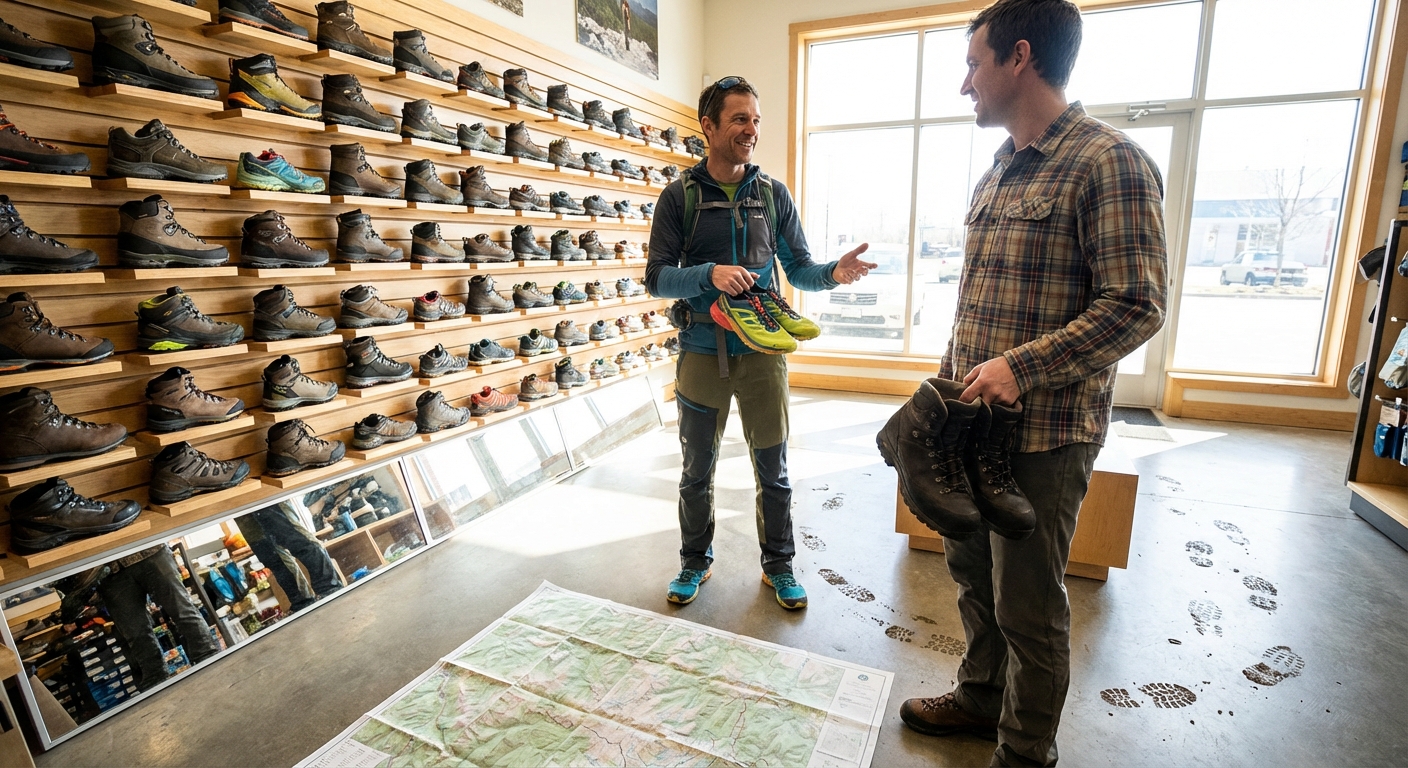
Every boot choice comes down to one tension: weight vs. protection/durability.
The Core Decision: Float Over Miles or Smash Through Terrain?
Carry less on your feet and you move faster with less fatigue. Add armor and structure, and you can bully your way through bad terrain and heavy loads. The sweet spot is different for a weekend warrior than for someone stringing together 25-mile days.
This guide compares light and heavy boot philosophies so you can pick what matches your real-world hiking.
Understanding Boot Weight Classes
For simplicity, we’ll define three classes (per pair, men’s 9-ish):
- Light: under ~2.2 lb (35 oz)
- Midweight: 2.2–3 lb (35–48 oz)
- Heavy: over 3 lb (48+ oz)
It doesn’t sound like much, but studies and real-world experience say 1 lb on your feet feels like 5 lb on your back. Over 10,000 steps, that adds up.
Class 1: Light Boots and Mids
These are built on a trail-runner mindset: foam-forward cushioning, flexible uppers, emphasis on comfort.
Pros
- Lower fatigue over long days
- Much faster break-in
- Kinder to knees and hips on repetitive, moderate terrain
- Often more breathable
- Less protection from sharp rocks and roots
- Softer foams pack out faster
- Less torsional stiffness on sidehills
- Often non-resoleable
- Maintained trail networks
- Ultralight or lightweight backpackers (<25–30 lb)
- Thru-hikers willing to replace footwear mid-route
- Salomon X Ultra 4 Mid GTX – A light boot that behaves like a fast hiker.
- HOKA Anacapa Mid GTX – Trail-runner comfort with mild ankle support.
Cons
Best for:
Examples:
Mileage expectation: 300–800 miles depending on terrain and load.
Class 2: Midweight Backpacking Boots
These boots split the difference. Enough support for a 30–40 lb pack, but still moving well on trail.
Pros
- Solid ankle and underfoot support
- Better rock and root protection
- Versatile for day hikes and multi-day trips alike
- Slower on easy terrain compared to lighter options
- Can feel hot in summer
- Break-in may take a few outings
- Traditional backpackers
- Hikers stepping up from day hikes to 2–7 day trips
- Mixed terrain users: some rock, some mud, some trail
- Lowa Renegade GTX Mid – Classic backpacking boot, very approachable.
- Scarpa Zodiac Plus GTX – More technical lean, good on rock.
Cons
Best for:
Examples:
Mileage expectation: 600–1000 miles with sane use and basic care.
Class 3: Heavy Leather and Mountaineering-Lite Boots
Full-grain leather, stiff shanks, stout rands. These are for when the terrain or load is the limiting factor, not your legs.
Pros
- Maximum protection
- Superior torsional stiffness on sidehills
- Better warmth and barrier in snow and wet brush
- Often resoleable; real long-term value for frequent users
- Heavy; you pay for every ounce with effort
- Truly need a break-in period
- Overkill on casual trails
- Heavy pack weights (40+ lb)
- Off-trail routes, talus, scree, bushwhacks
- Cold, wet, or snow-rich seasons
- Zamberlan Vioz GTX – Flagship tank boot for long, rough loads.
- Asolo TPS 520 / Power Matic – Guide-grade durability.
Cons
Best for:
Examples:
Mileage expectation: 800–1500+ miles, plus resoles.
Case Studies: Matching Boots to Real Hikers
1. The Weekend Peak Bagger
- Profile: Day packs, 8–14 miles, 3–4k ft gain on rough, rocky trails.
- Good choice: Midweight boot like Scarpa Zodiac Plus GTX.
- Why: Enough protection and edging on rock, but not full mountaineering stiffness.
- Profile: 2–3 night trips, 25–35 lb pack, mostly maintained trails.
- Good choice: Lighter midweight boot like Lowa Renegade GTX Mid.
- Why: Forgiving, supportive, and confidence-inspiring without feeling like bricks.
- Profile: Dry conditions, tons of sun, sand and rock, moderate loads.
- Good choice: Light non-waterproof boot or shoe (e.g., Salomon X Ultra 4 non-GTX).
- Why: Breathability and fast drying beat Gore‑Tex in consistent dry heat.
- Profile: Wet brush, mud, rooty trails, shoulder-season slop.
- Good choice: Waterproof midweight boot like Salewa Mountain Trainer Lite GTX.
- Why: Protection against constant wet, real traction on roots and mud.
- Profile: Steep, off‑trail routes, snowfields, occasional crampon use, heavier pack.
- Good choice: Stiff, heavy boot like Zamberlan Vioz GTX (or semi-auto crampon compatible equivalents).
- Why: Edge hold, compatibility with traction aids, and durability on rock.
2. The New Backpacker
3. The Desert Section Hiker
4. The Rainforest / PNW Local
5. The Alpine Aspirant
The Money Side: Cost Per Mile
Instead of fixating on sticker price, think cost per mile.
Example:
- Lightweight boot: $180, lasts ~500 miles → $0.36/mile
- Leather tank: $320, lasts 1200 miles + resole → first 1200 miles $0.27/mile, then even less post-resole.
- That 500-mile boot might last 3–4 years — you’ll age out of it before you wear it out.
- Premium, resoleable boots or multiple pairs of lighter boots both make financial sense, depending on your feet and style.
For casual hikers doing 100–150 miles a year:
For thru-hikers or mountain pros doing 1000+ miles a season:
Performance Factors That Matter More Than Weight on Paper
1. Fit and Foot Shape
Nothing beats fit. Not tech, not brand.
- Wide forefoot? Look at Keen Targhee, Altra, some Merrell.
- Narrow heels? Try Salewa, Scarpa, La Sportiva.
2. Midsole Support
A good rule: the rougher your terrain and the heavier your load, the stiffer you want the midsole.
Test by trying to twist the boot: if it folds like a sandal, it’s not for heavy packs in rough terrain.
3. Outsole Compound and Lug Pattern
- Softer rubber = better grip, faster wear.
- Harder rubber = longer life, possibly sketchier on wet rock.
Vibram Megagrip and equivalent compounds are a strong middle ground: sticky enough, still durable.
4. Waterproofing vs. Breathability
If you spend weeks in the wet, Gore‑Tex or similar earns its weight. If you live in the high desert, it mostly traps sweat.
Use membranes in truly wet, cool environments. Skip them for hot, dry, or mixed conditions where fast drying matters.
Practical Boot Selection Workflow
- Define your maximum load (worst-case pack weight).
- Map your typical terrain: groomed trail, rocky, off‑trail, winter.
- Be honest about your annual mileage.
- Choose a weight class that supports 1–3.
- Shortlist 2–3 boots that fit your foot type.
- Try them late in the day with your real socks.
- Walk ramps, stairs, and slopes; adjust lacing to lock the heel.
If one pair disappears on your feet while walking around the shop and the others demand your attention, the quiet pair wins.
Care Tactics to Stretch Your Investment
- Keep them clean: Dirt and salt are abrasive.
- Dry them right: Room temperature, good airflow, no direct heat.
- Reproof fabric/leather: When water stops beading, renew DWR.
- Condition leather sparingly: Enough to keep it supple, not so much it turns into a slipper.
The math is simple: more care = more miles per dollar, regardless of weight class.
The Bottom Line
Ultralight evangelists will tell you anything over 2 lb is barbaric. Old-school hardmen will tell you anything under 3 lb is a sneaker.
Both are wrong for some hikers and right for others.
Pick boots the way you’d pick a tool: match them to the job, your body, and how often you’re swinging them. Then go test them on real dirt — not just your living room carpet.