
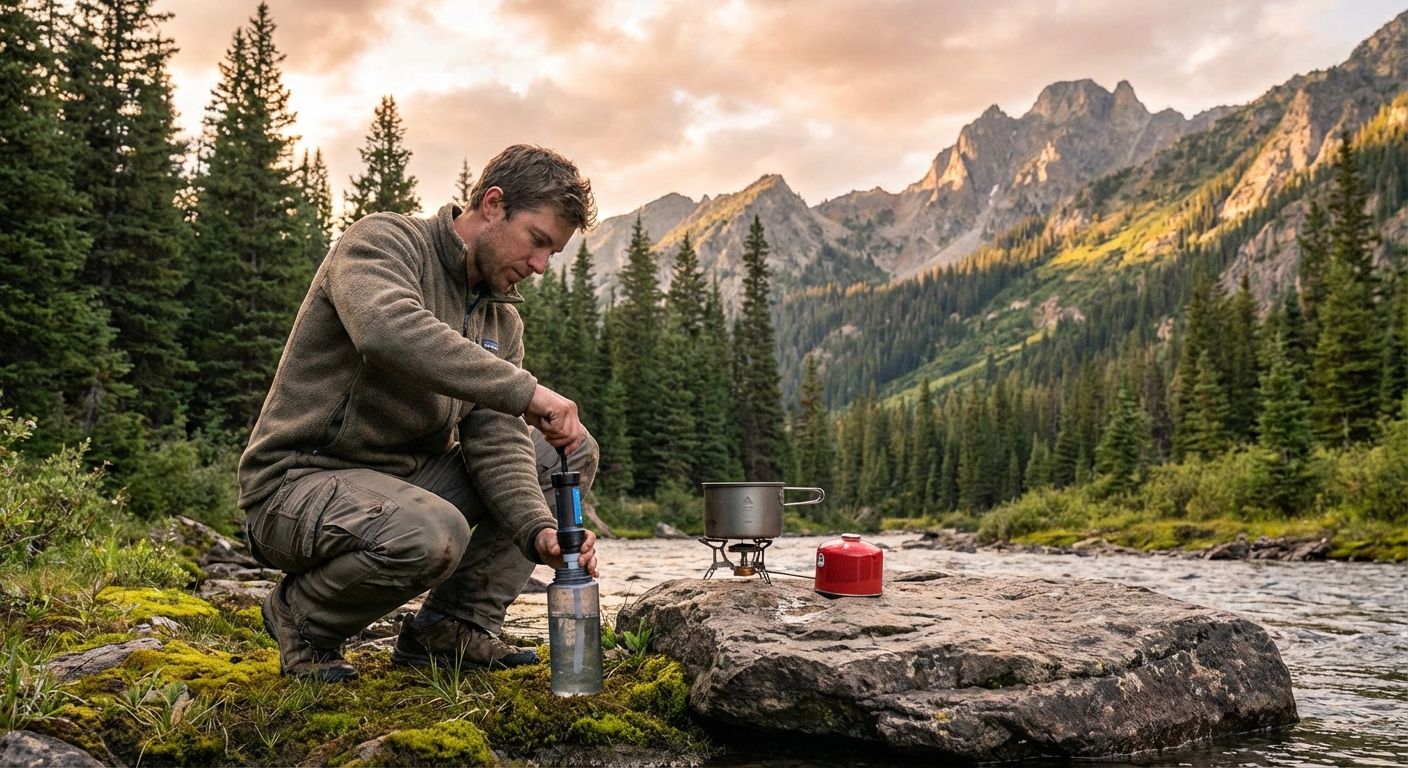
You can’t control the weather, the terrain, or that blowdown mess two miles ahead. You can control your water and fuel. Get those wrong, and everything else gets harder.
Control What You Can: Water and Fuel
This playbook walks through how to pull water from questionable sources, make it safe, and keep your stove burning from trailhead to last camp.
Reading and Working Marginal Water Sources
Out there, “running water” isn’t always the crystal stream from the brochure.
Types of Sources You’ll See
Clear, Fast Streams
Best option. Pull from mid‑current, upstream of trails, camps, and livestock.
Ponds and Lakes
Slower water, more sediment and life. Prefilter and treat carefully.
Cow Tanks, Troughs, and Algae Ponds
Last‑resort sources. Expect sediment, bacteria, and taste issues. Treat aggressively.
Tiny Seeps and Trickles
Common on ridge walks and desert routes. Hard to fill from, but often safer than stagnant pools if distant from grazing.
Smart Collection Techniques
- Prefilter dirty water: Use a bandana, coffee filter, or clean buff to strain out debris before filtering or treating.
- Dip, don’t dredge: Skim surface water where it’s clearest instead of scraping muck from the bottom.
- Use a scoop bottle: Cut‑off bottle or collapsible scoop makes shallow sources much easier.
Treatment Methods: When to Use What
Squeeze Filters (Primary for Most Hikers)
Good for: Day hikes, section hikes, thru‑hikes with mixed sources.
Key Pros:
- Lightweight, compact, no chemicals.
- Good flow rate when clean.
- Can clog in silty water.
- Ruined if frozen.
Key Cons:
Field Tips:
- Backflush regularly—dirty water slows filters fast.
- Keep the “dirty” and “clean” sides clearly separate to avoid cross‑contamination. Label caps or use different bottles.
- In freezing conditions, sleep with your filter in a zip bag in your bag or pocket.
Chemical Treatment
Chlorine dioxide drops or tablets are the standard.
Pros:
- Ultralight, nearly no space.
- Zero moving parts to break.
- Great backup.
- 15–30 minutes wait for most pathogens; longer for some.
- Doesn’t remove sediment.
- Some folks dislike the taste.
Cons:
Best Use: Backup to a filter, winter trips, fast‑and‑light warm conditions with generally clear water.
Boiling
Pros:
- Reliable if done properly.
- No gear beyond stove and pot.
- Fuel heavy.
- Slower if you need to boil all water, not just cooking water.
Cons:
Guideline: Bring water to a rolling boil for at least 1 minute (3 minutes above ~6,500 ft / 2,000 m). Let cool before drinking.
Use boiling when:
- Your filter fails and you’re out of chemicals.
- Water is extremely questionable and you want redundancy (prefilter + boil + maybe chemical).
- You’re already boiling for meals.
Fuel Management: Don’t Run Dry Before the Ridge
Water isn’t the only liquid that can end your day early. Running out of cooking fuel when you’re banking on hot food is a morale hit that echoes.
Estimating Fuel Needs
Canister Fuel (3‑Season, Boil‑Only)
- 6–10 g fuel per 500 ml boil.
- 20–30 g/day for dinner + hot drink or breakfast.
Roughly:
- 100 g canister: 4–6 days solo light use.
- 230 g canister: 8–12 days solo.
Wind, cold, and big cooking will push you to the upper end.
Alcohol Fuel
- 18–24 ml (0.6–0.8 oz) per 500 ml boil.
- 45–60 ml/day for two boils.
Real‑World Fuel Stretching Tactics
- Always use a lid.
- Find natural windbreaks (logs, rocks) or use an appropriate windscreen.
- Simmer instead of full blast when cooking thicker meals.
- Pre‑soak foods (like noodles or rice) in cold water for 10–15 minutes before heating—cuts boil time and fuel.
Fuel Choices by Trip Type
Weekend Forest Hike
- Best bet: Canister stove and 100 g canister. Fast, no fuss.
- Backup: A few chemical tabs for water and maybe a small emergency Esbit tab.
Multi‑Week Thru‑Hike (3‑Season)
- Best bet: Canister stove or alcohol, depending on your comfort and resupply.
- Key: Know where you can buy canisters or alcohol on‑trail. Don’t assume—verify in recent trail reports.
Winter or High‑Altitude
- Best bet: Liquid fuel stove or very cold‑weather‑tuned canister system.
- Note: Boiling may become your default water treatment method; plan fuel accordingly.
Water & Fuel Safety in Real Conditions
Freezing Temperatures
Water bottles, filters, and canisters all act differently in the cold.
- Filters: Never let them freeze wet. If they do and you can’t be 100% sure they didn’t, consider them compromised.
- Bladders: Hoses freeze first. Blow water back into the bladder after each sip. Insulate tubes or switch to bottles in very cold weather.
- Canisters: Performance drops with cold. Sleep with your canister or warm it in your jacket (outside your base layer) before use.
Heat and High Sun
- Store fuel and water in the shade at camp if possible.
- Don’t leave canisters baking on hot rocks.
- Use light‑colored bottles or insulators if water heating up constantly is an issue.
System Care: Keep It Working Trip After Trip
Hydration System Care
- Rinse and dry bottles after each trip; open caps and store dry.
- For bladders: use cleaning tabs or light soap, rinse thoroughly, hang fully open.
- Replace soft bottles that go cloudy, stiff, or develop off smells.
Filter Care
- Backflush as recommended by the maker, more often with silty sources.
- Store mostly dry between trips but not in direct sunlight.
- Cap both ends to keep dust out.
Stove and Fuel Care
- Wipe down stove after gritty or sandy trips.
- Check pot supports for bending or loosening.
- Inspect canister valve area before each attachment; listen for hiss when attaching.
- Don’t leave partially used canisters attached to stoves in storage for weeks.
Example Setups: Matching Water & Fuel Systems
Lightweight Weekend Kit (Solo)
- Water: Two 1 L soft bottles + option for extra 1–2 L collapsible bag.
- Treatment: Squeeze filter + 5–10 chemical tabs.
- Cooking: Small canister stove + 750–900 ml pot + 100 g canister.
Thru‑Hike Mixed Terrain Kit
- Water: 3–4 L total capacity (mix bottles/bags).
- Treatment: Squeeze filter, chemical backup.
- Cooking: Mid‑range canister stove, 750–900 ml titanium pot, 230 g canisters between larger resupply points.
Harsh Desert Section Kit
- Water: 5–7 L capacity with rugged bottles and collapsibles.
- Treatment: Filter + chemicals (some sources may need double treatment and extra caution).
- Cooking: Stove optional—if bringing it, plan on heavy water loads anyway. In extreme heat, many hikers shift toward no‑cook volumes.
The Bottom Line
You don’t need a perfect forecast or perfect gear to move safely and comfortably, but you do need a real plan for both water and fuel.
Scout your sources, choose treatment that matches the terrain, carry fuel with margin, and run a system you can operate half‑frozen in the dark.
Control your water and fire, and the rest of the trip gets a whole lot simpler.