
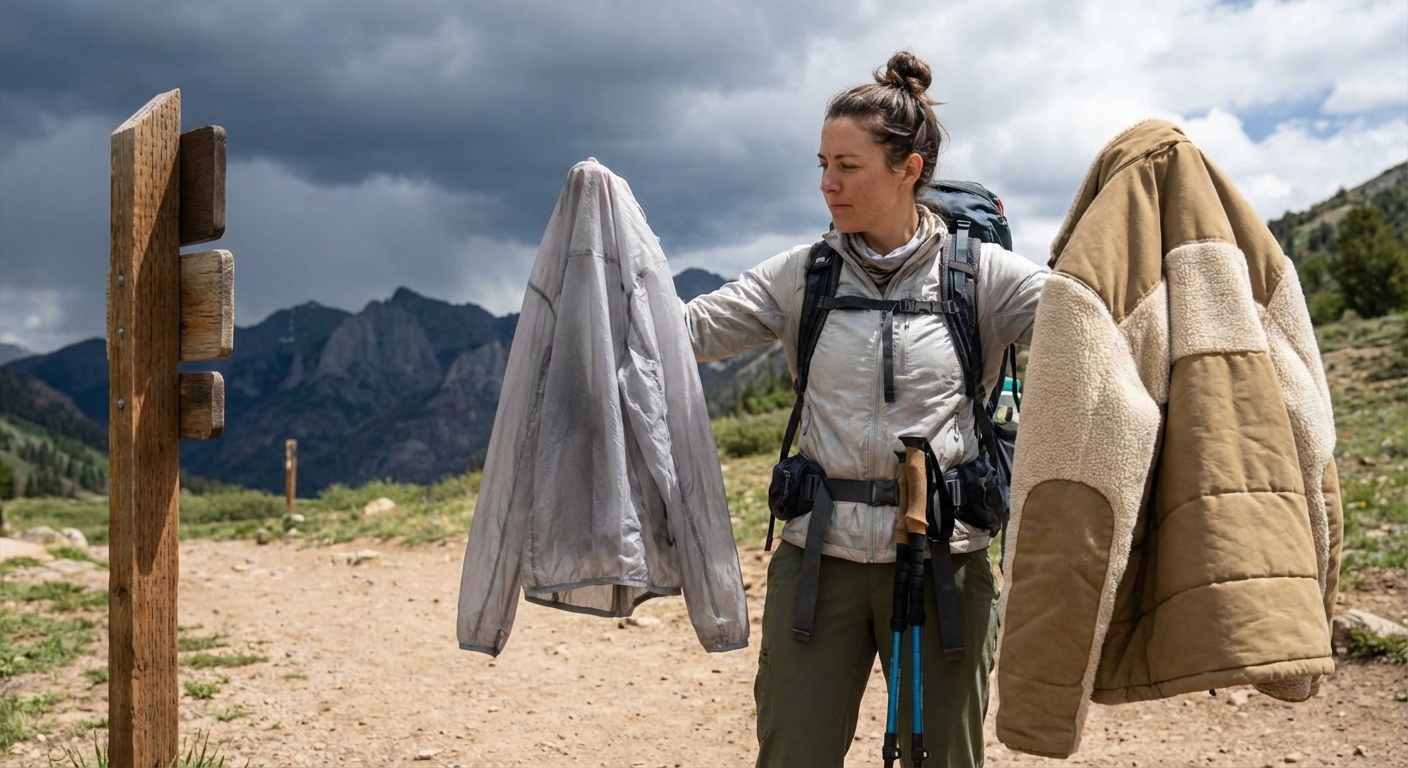
Look around any popular trailhead and you’ll see two tribes:
Two Ways to Dress for the Trail
- Ultralight crowd – paper-thin wind shirts, trail runners, tiny packs.
- Bombproof crew – heavy boots, thick canvas pants, burly shells.
Both groups stay alive and reach their camps. Both also make compromises. The question isn’t who’s right—it’s what’s right for you.
This guide breaks down the trade-offs in real numbers: durability vs. weight vs. cost. Then we’ll map out apparel systems for three hiking styles so you can stop guessing and start dialing in.
The Big Three Apparel Trade-Offs
Every piece of trail clothing sits on a three-way scale.
- Weight – Lighter feels great on long climbs and big mileage days.
- Durability – Tough fabric shrugs off bushwhacks and rock scrapes.
- Price – Good gear isn’t cheap; cheap gear rarely lasts a thru-hike.
You can usually pick two:
- Light + Durable = Expensive (high-end softshells, top-tier down)
- Light + Cheap = Fragile (budget UL layers)
- Durable + Cheap = Heavy (old-school hiking pants, generic fleeces)
Knowing which corner you’re aiming for is half the battle.
Weight Benchmarks: What’s Actually “Light”?
Here are rough targets for common apparel items:
- Base layer top (long sleeve): 4–7 oz (113–198 g)
- Fleece midlayer: 9–14 oz (255–397 g)
- Puffy jacket: 7–13 oz (198–369 g)
- Rain shell: 6–14 oz (170–397 g)
- Softshell pants: 8–16 oz (227–454 g)
If something is double these numbers, you’re paying for extra features or armor. Decide if you truly need them.
Fabric Reality Check: What Holds Up, What Doesn’t
Lightweight Wonder Fabrics (30–50D and below)
You’ll see 10D to 30D in ultralight jackets and pants. That “D” is denier—fiber thickness.
- Pros: Featherweight, pack tiny, feel incredible.
- Cons: Vulnerable to tearing on thorns, rock, and rough bark.
Great for:
- Maintained trails
- Mild weather
- Experienced hikers who move carefully
Risky for:
- Off-trail routes
- Scrambles, talus, slide alder
- Work trips (trail building, guiding)
Midweight Workhorses (50–100D)
Most reliable gear lives here.
- Pros: Balanced weight and durability, good for regular use.
- Cons: Not the lightest, but far from bricks.
Look for:
- 60–80D rain shells for backpacking
- 70–100D pants for brushy trails
Heavy Armor (100D+)
- Pros: Takes abuse: chimneying, scree sliding, trail work.
- Cons: You feel it every step.
These pieces shine for:
- Guides, SAR, trail crew
- Bushwhacks and scrambles
Three Trail Personas: Which One Are You (Most of the Time)?
1. The Weekend Hiker Who Wants Reliability
You’re out 1–4 nights at a time, sticking mostly to marked trails.
Your priorities:
- Comfort
- Reasonable weight
- Gear that lasts a few seasons
Suggested Apparel Setup
- Base layer: Synthetic long-sleeve (5–6 oz).
- Budget: REI Lightweight Base, Decathlon Tech Tee.
- Midlayer: Grid-fleece hoodie (11–14 oz).
- Budget: Columbia or REI fleece hoodie.
- Mid-range: Patagonia R1-style top.
- Insulation: Synthetic puffy (10–13 oz).
- Eg: REI 650-fill synthetic, Patagonia Nano Puff.
- Shell: 2.5L rain jacket (10–14 oz).
- Eg: Marmot PreCip, REI Rainier.
- Pants: Midweight durable hiking pants (12–16 oz).
- Eg: Eddie Bauer Guide Pro, Prana Stretch Zion.
Total clothing carried (not worn): ~2.5–3.5 lb (1.1–1.6 kg).
Rugged enough, not absurdly heavy.
2. The Mileage Hunter and Thru-Hiker
You’re stringing together 20–30 mile days, maybe months on trail.
Your priorities:
- Weight savings
- Breathability
- Quick dry
You’ll accept some fragility and mid-hike repairs.
Suggested Apparel Setup
- Base layer: Lightweight merino or synthetic tee (3–5 oz).
- Eg: Smartwool 150, Patagonia Capilene Cool.
- Active midlayer: Light fleece or active insulation (8–11 oz).
- Eg: Decathlon Forclaz fleece, R1-style grid fleece.
- Camp insulation: Ultralight down or synthetic puffy (7–10 oz).
- Eg: Mountain Hardwear Ghost Whisperer/2, REI Magma.
- Wind shell: 2–3.5 oz nylon wind shirt.
- Eg: Patagonia Houdini, Rab Vital.
- Rain shell: Minimal but real 2.5–3L jacket (6–10 oz).
- Eg: OR Helium, Rab Kinetic.
- Bottoms: Running shorts or UL pants (5–9 oz).
- Eg: Nike/Salomon running shorts, OR Ferrosi pants.
Total clothing carried (not worn): ~1.5–2.2 lb (0.7–1.0 kg).
You’ll patch holes and maybe replace at least one major piece mid-hike. That’s the cost of going light over thousands of miles.
3. The Hard-Use Bushwhacker and Trail Worker
You’re bashing through alder, crawling over blowdowns, maybe swinging tools.
Your priorities:
- Durability
- Protection
- Acceptable comfort
Weight matters, but it’s secondary.
Suggested Apparel Setup
- Base layer: Synthetic long-sleeve (6–8 oz).
- Tougher knit, better abrasion resistance.
- Midlayer: Heavyweight fleece or rugged softshell (14–22 oz).
- Eg: Carhartt fleece, thicker softshell jacket.
- Insulation: Robust synthetic puffy (12–18 oz).
- Eg: Workwear brands or thicker outdoor synthetics.
- Shell: Heavy 3L rain jacket with 70–100D fabric (14–24 oz).
- Eg: Arc’teryx Beta AR, Rab Latok, heavy-duty Helly Hansen.
- Pants: Reinforced work/hiking pants (16–28 oz).
- Eg: Fjällräven G-1000, Carhartt-style work pants, Kuhl with reinforced knees/seat.
You’ll sweat more and carry more, but you won’t shred gear on day two.
Where to Spend and Where to Save
If your budget isn’t bottomless (most aren’t), prioritize.
Spend More On
- Footwear and socks – Comfort + blister prevention.
- Rain shell – Cheap ones fail fast in real storms.
- Insulation layer – Core warmth is safety, not luxury.
Save Money On
- Base layers – Decent synthetics from budget brands work fine.
- Fleece – Basic grid-fleece or work fleece does 90% of what premium does.
- Trail pants – Mid-priced stretch hiking pants are usually enough.
Practical Field-Tested Combos (By Budget)
Budget Kit (~$250–350 total)
- Synthetic tee (Decathlon, $15–20)
- Generic grid-fleece hoodie (Amazon/Decathlon, $35–50)
- Budget synthetic puffy (Decathlon/REI, $80–120)
- Marmot PreCip or REI Rainier rain jacket ($90–120)
- Eddie Bauer Guide Pro pants ($40–70 on sale)
- Darn Tough or similar socks ($20–25)
Pros: Reliable, affordable, good for almost all 3-season trips.
Cons: Heavier than UL setups; bulkier to pack.
Mid-Range Kit (~$500–750 total)
- Merino or Capilene base layer ($50–70)
- Quality grid-fleece midlayer ($90–130)
- Midweight down puffy ($180–230)
- Solid 3L rain shell ($180–250)
- Stretch hiking pants ($80–120)
Pros: Balanced performance, still reasonably durable.
Cons: Higher upfront cost.
Ultralight-Curated Kit (~$700–1,000 total)
- Lightweight merino or performance synthetic ($60–90)
- UL active insulation or thin fleece ($120–180)
- Ultralight down jacket ($220–320)
- Ultralight 3L or high-end 2.5L shell ($220–350)
- UL pants or running shorts ($60–120)
Pros: Feels amazing on big-mile days.
Cons: Higher risk of damage; needs careful handling.
Making the Call: A Simple Decision Framework
Ask yourself:
How far and how often am I really hiking?
- Under 10 trips/year: lean more durable/cheaper. - Thru-hike or guiding: prioritize weight and quality.
What terrain and climate?
- Scrubby, rocky, off-trail: push toward durability. - Groomed trails, forest cover: you can go lighter.
What’s my tolerance for discomfort?
- Hate being cold/wet: invest in shell + insulation. - Okay with some suffering to move fast: trim weight.
You don’t have to be 100% ultralight or 100% bombproof. Most experienced hikers end up hybrid: light where it counts, armored where it fails most.
Final Take: The Trail Is the Only Real Test
Start with what you have, upgrade one piece at a time, and pay attention to where your system lets you down:
- Cold at camp? Improve insulation.
- Soaked in a drizzle? Upgrade the shell.
- Constantly patching pants? Go one step heavier.
The sweet spot is personal. Use the trail as your proving ground, not the gear catalog.